
In South Africa, many people wonder: are private investigators legal? As a seasoned private investigator at Royal Investigations, I often encounter this question — sometimes from prospective clients who are unsure whether engaging a PI is lawful, other times from individuals worrying whether they might be infringing privacy laws themselves by conducting informal private inquiries.
Private investigation is a lawful profession in South Africa, unlike in certain countries such as China, North Korea, and Saudi Arabia, where private investigative activities are either heavily restricted or prohibited by law.
In South Africa, the private security and private investigation industry is regulated by the Private Security Industry Regulatory Authority (PSIRA). Any person offering private investigation services must be properly registered with PSIRA and comply with the applicable legislative and regulatory requirements. Operating as a private investigator without the necessary registration or license is unlawful and may result in criminal and regulatory action.
Statsitics relating to unregistered private investigators in South Africa:
Interesting Statistic: Illegal Operators Under Pressure
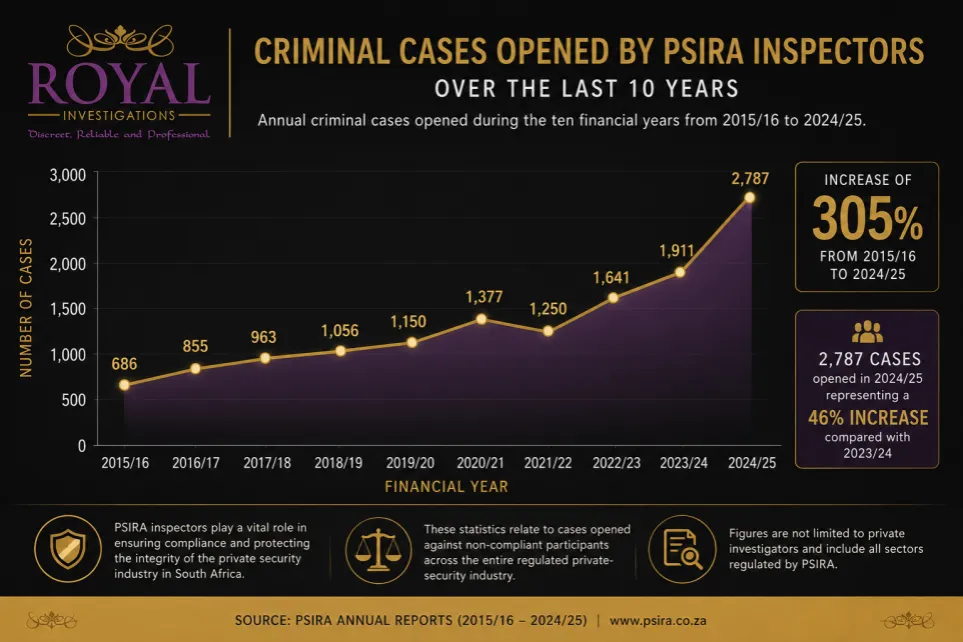
PSIRA Enforcement Has Increased by More Than 300% in a Decade
Although the Private Security Industry Regulatory Authority (PSIRA) does not separately report statistics for illegal private investigators and illegal private security companies, its annual reports clearly show a dramatic increase in enforcement against unregistered operators.
Key Statistics
- 2015/16: 686 criminal cases opened against illegal operators.
- 2024/25: 2,787 criminal cases opened.
- Increase: 2,101 additional criminal cases over the decade.
- Overall Growth: Approximately 306% in 10 years.
- Equivalent to: More than 4 times as many criminal cases as were recorded in 2015/16.
Did You Know?
PSIRA inspectors now register almost 8 criminal cases every day against suspected illegal operators, based on the 2024/25 annual figures.
Expert Insight
While these statistics relate to all illegal operators regulated by PSIRA—including unregistered private security companies and private investigators—they should not necessarily be interpreted as evidence that PSIRA has become significantly more effective at enforcement. Rather, the data suggests that the number of illegal operators has grown substantially over the past decade, resulting in a corresponding increase in criminal cases registered by PSIRA inspectors. Despite thousands of criminal cases being opened each year, it is reasonable to conclude that many unregistered operators continue to function undetected. The reported figures therefore likely represent only a small proportion of the true scale of illegal activity within the private security and private investigation sectors in South Africa.



What Private Investigators Can and Cannot Do in South Africa
One of the biggest misconceptions about private investigators is that operating legally means every investigation follows a neat, predictable checklist. The reality is far more complex.
Private investigation is not a profession where success comes from simply following a list of “do’s and don’ts.” Every case presents unique challenges, and the difference between an average investigator and an exceptional one often lies in understanding the law well enough to know where the boundaries are—and how to work effectively within them.
At Royal Investigations, we are frequently told that we “push the envelope.” There is some truth to that, but it is important to understand what that actually means. It does not mean breaking the law, hacking into private accounts, intercepting communications, trespassing, or unlawfully invading a person’s privacy. Those actions are illegal and have no place in a professional investigation.
What it does mean is that we constantly challenge conventional thinking. We explore every lawful investigative avenue, use creative and innovative techniques, and maximise every opportunity the law affords us to obtain evidence that benefits our clients. Experienced investigators understand where the legal boundaries lie and know how to operate confidently right up to those boundaries without crossing them.
South African investigators operate within a comprehensive legal framework that includes legislation such as the Regulation of Interception of Communications, the Protection of Personal Information Act (POPIA), the Constitution and Bill of Rights, the Criminal Procedure Act, and various principles of common law. These laws exist to protect everyone’s rights, and they should never be ignored.
The true skill of a professional private investigator is not found in breaking the rules—it is found in understanding them so thoroughly that every legitimate investigative opportunity can be used to its fullest advantage. Knowing the difference between an unlawful invasion of privacy and a lawful intelligence-gathering exercise is what separates experienced professionals from amateurs.
Ultimately, successful investigations are not about taking illegal shortcuts. They are about combining legal knowledge, investigative experience, strategic thinking, and persistence to uncover the truth while ensuring that the evidence obtained can withstand scrutiny in court. That is the standard we hold ourselves to on every investigation.
This is why experience is not bought at a corner shop. This is the very reason why we are by far the best private investigation agency in Johannesburg, Pretoria and Cape Town. We also service the whole of South Africa.


The State of Private Investigations in South Africa
The private investigation industry in South Africa has evolved significantly over the past decade. Once largely associated with matrimonial investigations, the profession has developed into a highly specialised sector that provides critical support to businesses, legal professionals, insurers, and private individuals.
According to a 2017 report by PSiRA, South Africa had 546 registered private investigators. While more recent official figures have not been published, industry demand has grown considerably, suggesting that the number of registered investigators has increased alongside the expanding need for professional investigative services.
Today’s private investigators are routinely instructed to conduct:
- Asset tracing investigations
- Background checks
- Child custody investigations
- Infidelity and cheating spouse investigations
- Murder investigations
- Surveillance
- Cyber crime investigations
- Fraud Investigations
This shift reflects a broader recognition of private investigators as licensed, regulated professionals who play an important role in gathering lawful evidence, uncovering hidden facts, and supporting legal and commercial decision-making. Increasingly, private investigators work alongside attorneys, forensic accountants, insurers, corporate compliance departments, and law enforcement agencies to assist in complex civil, commercial, and criminal-related matters.
The continued growth of the industry demonstrates that private investigation is no longer a niche profession focused solely on infidelity cases. Instead, it has become an essential component of corporate governance, fraud prevention, risk management, dispute resolution, and the broader administration of justice in South Africa. When conducted lawfully and within the framework of PSiRA regulation, private investigation provides a valuable public service that benefits businesses, legal practitioners, and society as a whole.
What Clients Should Know Before Hiring a Private Investigator
Hiring a private investigator is an important decision. Whether you need assistance with a fraud investigation, asset trace, surveillance operation, or litigation support, choosing the right investigator can make a significant difference to the outcome of your matter. Before appointing a private investigator in South Africa, consider the following practical guidelines.
1. Verify PSiRA Registration
Always confirm that both the investigator and the investigation agency are registered with the Private Security Industry Regulatory Authority (PSiRA). A legitimate investigator should have no hesitation in providing their registration details. Operating as a private investigator without the required registration is unlawful in South Africa.
2. Request a Clear Written Agreement
A professional investigation should always begin with a written mandate or service agreement. The agreement should clearly define the scope of the investigation, the services to be performed, estimated timeframes, reporting procedures, and the associated costs. Be cautious of investigators who provide vague quotations or continually increase their fees without justification.
3. Ensure the Investigation Will Be Conducted Lawfully
A reputable private investigator works within the boundaries of South African law. Investigators should never offer to hack into devices, intercept communications unlawfully, trespass onto private property, impersonate police officers, or engage in intimidation or harassment. Evidence obtained unlawfully may be inadmissible and could expose both the investigator and the client to legal consequences.
4. Involve Your Attorney Where Appropriate
If the investigation relates to pending or anticipated legal proceedings, your attorney should be involved from the outset. Proper evidence preservation, chain of custody, witness statements, affidavits, and legally compliant reporting are all critical to ensuring that the information gathered can be effectively used during litigation.
5. Understand the Role of a Private Investigator
Private investigators uncover facts—they do not guarantee outcomes. They cannot arrest suspects, compel witnesses to cooperate, or force institutions to disclose confidential information. Their role is to lawfully obtain, analyse, and document evidence that enables clients and their legal representatives to make informed decisions.
6. Avoid Unregistered or "Fly-by-Night" Operators
Price should never be the only deciding factor. Extremely low-cost investigators often operate without the necessary licensing, insurance, experience, or professional standards. Before making a decision, review the agency’s credentials, website, client testimonials, years of experience, and professional reputation.
Our Commitment
At Royal Investigations, we believe professionalism begins with integrity. Every investigation is conducted within the framework of South African law and industry regulations. We maintain strict confidentiality, document our findings meticulously, preserve the integrity of evidence, and provide clients with clear, objective, and transparent reports. Our objective is not simply to gather information—it is to deliver reliable, legally defensible evidence that assists our clients in making informed decisions and, where necessary, supports successful legal proceedings.

FAQs — Answering What People Often Ask
1. Are private investigators legal in South Africa?
Yes. Private investigators are completely legal in South Africa, provided they are registered with the Private Security Industry Regulatory Authority (PSIRA). It is unlawful to operate as a private investigator without the required PSIRA registration.
2. Do private investigators need a licence in South Africa?
Yes. Every professional private investigator and private investigation agency must be registered with PSIRA before offering investigative services. Hiring a registered investigator helps ensure your investigation is conducted lawfully and ethically.
3. Can a private investigator legally conduct surveillance?
Yes. Surveillance is one of the core functions of a private investigator. However, surveillance must always be conducted within the boundaries of South African law, including compliance with the Constitution, POPIA, and other applicable legislation.
4. Can private investigators access bank accounts, phone records or WhatsApp messages?
No. A legitimate private investigator cannot unlawfully access someone’s bank accounts, mobile phone records, emails, WhatsApp messages, or any other private communications. Any investigator offering these services is likely acting illegally.
5. Can a private investigator make an arrest in South Africa?
Generally, no. Private investigators have no special arrest powers beyond those available to any ordinary citizen under Section 42 of the Criminal Procedure Act. Their role is to gather evidence, not enforce the law.
6. What types of investigations do private investigators conduct?
Private investigators assist with a wide range of matters, including:
- Fraud investigations
- Asset tracing
- Background checks
- Infidelity investigations
- Missing persons
- Child custody investigations
- Corporate investigations
- Cybercrime investigations
- Surveillance operations
- Litigation support
7. Is evidence collected by a private investigator admissible in court?
Yes. Evidence lawfully obtained by a professional private investigator can often be used in civil or criminal proceedings. Proper documentation, chain of custody, and compliance with South African law are essential to maximise its evidential value.
8. How do I know if a private investigator is legitimate?
Always verify that both the investigator and the agency are registered with PSIRA. You should also request a written service agreement, review client testimonials, confirm their experience, and ensure they follow lawful investigative practices.
9. Why should I avoid unregistered private investigators?
Unregistered investigators often operate outside the law, placing both themselves and their clients at risk. Evidence obtained illegally may be inadmissible in court, and clients could become involved in legal disputes arising from unlawful investigative methods.
10. Why should I choose Royal Investigations?
Royal Investigations is one of South Africa’s leading private investigation firms, providing professional investigative services throughout Johannesburg, Pretoria, Cape Town, and across South Africa. Every investigation is conducted lawfully, confidentially, and in accordance with PSIRA regulations, with a strong focus on producing reliable, court-ready evidence for individuals, businesses, attorneys, and insurers.