
Can PI’S Get Access to WhatsApp Messages?
Private investigators (PIs) are often approached with requests to retrieve WhatsApp messages, either to uncover infidelity, fraud, or other forms of misconduct. However, accessing private messages on WhatsApp without the explicit consent of the owner is not only nearly impossible due to technological safeguards but also illegal under South African law. This blog post will explore the reasons why private investigators cannot and should not attempt to access WhatsApp messages, the legal consequences of unauthorized access, and the ethical investigative alternatives available.
South Africa is governed by the rule of law, and there are strict legal protections in place for people’s privacy and personal information. Accessing, monitoring, or intercepting someone’s private messages or communications without their knowledge or consent is not only unethical—it can also amount to a criminal offence.
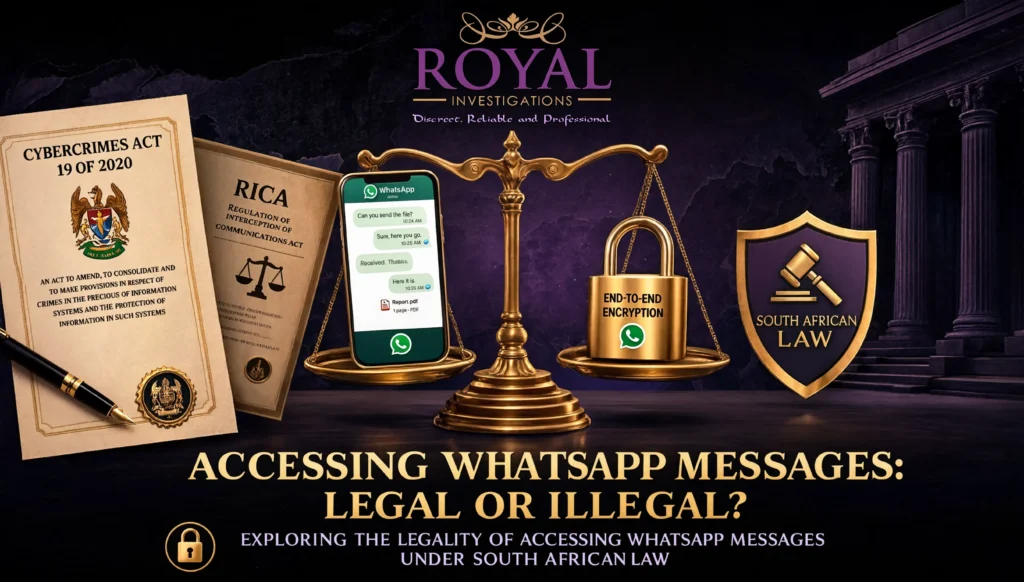
The Cybercrimes Act 19 of 2020 prohibits the unlawful access, interception, or monitoring of electronic communications and data. In addition, such conduct may also contravene the Regulation of Interception of Communications and Provision of Communication-Related Information Act (RICA), which strictly regulates when and how communications may be lawfully intercepted.
The consequences can be serious. Anyone who unlawfully accesses another person’s private communications could face criminal prosecution, civil claims, and significant legal penalties. Simply put, invading someone’s privacy in this way is a risk that is rarely worth taking.
The Security of WhatsApp – End-to-End Encryption
WhatsApp, owned by Meta (formerly Facebook), uses end-to-end encryption to secure user messages. This encryption ensures that messages are encoded from the sender’s device and can only be decoded on the recipient’s device. Even WhatsApp itself cannot access or read the messages being exchanged.
How Does End-to-End Encryption Work?
- When a message is sent, it is encrypted on the sender’s device.
- The encrypted message is transmitted through WhatsApp’s servers.
- Only the intended recipient’s device has the cryptographic key to decrypt and read the message.
This system makes it practically impossible for any third party, including private investigators, to intercept and read messages without access to the recipient’s physical device and authentication credentials.
One of the most common requests we receive is from clients asking us to gain access to their partner’s WhatsApp messages. Unfortunately, when we explain that we operate within the law and will not engage in illegal hacking, many of them eventually find someone online who claims they can “hack” a WhatsApp account.
In our experience, this is how the scam usually unfolds:
1. They promise the impossible.
The scammer confidently assures you that they can hack into your partner’s WhatsApp account and recover every message, photo, and voice note.
2. They gather information from you.
Before doing anything, they ask detailed questions about your relationship, your suspicions, names of people involved, dates, and what you believe is happening. At the time, it seems like they are gathering intelligence for the “hack.” In reality, they are collecting material to build a believable story.
3. They pretend to carry out the hack.
After a few hours or days of silence, they tell you they have successfully gained access to the account.
4. They create fake evidence.
Instead of hacking anything, many scammers simply use freely available tools such as a fake WhatsApp chat generator to fabricate realistic-looking conversations. They tailor these fake chats using the information you unknowingly provided them, making the messages appear convincing and personal.
5. You receive the "proof."
The scammer sends you screenshots or chat logs that look authentic. Believing them to be genuine, you may confront your partner, make life-changing decisions, initiate divorce proceedings, or even use the fabricated messages in legal disputes.
This is where the real danger lies.
A fake WhatsApp conversation can destroy relationships, damage reputations, influence child custody disputes, and lead people to make irreversible decisions based on evidence that was completely manufactured.
As professional private investigators, we have seen how devastating this can be. If someone claims they can hack a WhatsApp account for a fee, approach that claim with extreme caution. In many cases, you are not paying for evidence—you are paying for a carefully constructed fiction.
If you genuinely suspect infidelity or misconduct, there are lawful and ethical investigation methods available that can produce reliable, court-admissible evidence. Illegal “WhatsApp hacking” is not one of them.
Don’t risk your money, your relationship, or your future based on fake evidence. Stay away from anyone promising to hack WhatsApp accounts.


Real-World Consequences of Unlawful Hacking
Unauthorized hacking of communication platforms has led to high-profile legal actions globally. In the UK, the Leveson Inquiry uncovered mass phone hacking by journalists, leading to stricter regulations. Similarly, Prince Harry recently won a case against a newspaper that illegally accessed his personal data through private investigators.
South African PIs must operate within legal boundaries to avoid severe legal and reputational damage.
Can a Private Investigator Legally Access WhatsApp Messages?
The Only Legal Method: Explicit Consent
The only legal way for a private investigator to obtain WhatsApp messages is with the explicit consent of the device owner. If an individual willingly provides their phone and grants access to their messages, a PI can review them as part of an investigation.
However, coercion or deception to obtain consent is illegal, and ethical investigators avoid such practices.
Ethical and Legal Alternatives for Investigations
Although private investigators cannot hack into WhatsApp, they have numerous legal investigative techniques to gather information:
- Surveillance
- Observing a subject’s activities to uncover suspicious behavior.
- Social Media Investigation
- Reviewing public digital footprints on platforms like Facebook, Instagram, and LinkedIn.
- Forensic Analysis of Devices (With Consent)
- Examining legally obtained digital devices for relevant data.
- Public Records and Background Checks
- Investigating financial records, business affiliations, and legal documents.
- Interviews and Witness Statements
Gathering information from credible sources related to the case.

Frequently Asked Questions
Can a private investigator get deleted WhatsApp messages?
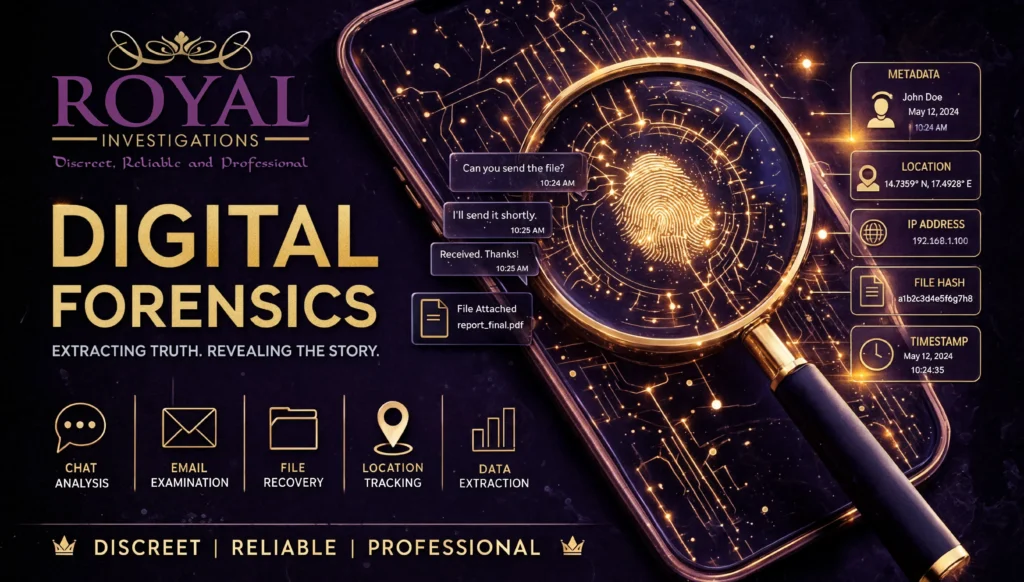
Generally, deleted WhatsApp messages can be easily retrieved. The device needs to be subjected to digital forensic analyses.
Can a private investigator get access to text messages?
A private investigator cannot legally obtain your text messages without consent or a legal warrant. However, if they have physical access to a device, they may be able to retrieve some data using forensic tools.
Can someone get access to your WhatsApp messages?
If someone gains access to your phone, backup files, or links your account to another device via WhatsApp Web, they may be able to view your messages. Always enable two-step verification to enhance security
Can WhatsApp messages be used in an investigation?
Yes, WhatsApp messages can be used as evidence in an investigation if they are obtained legally. Screenshots, backups, or extracted data may be presented in court.
Can WhatsApp messages be recovered?
Yes, if a backup exists, WhatsApp messages can be restored from Google Drive (Android) or iCloud (iPhone). If no backup is available, forensic tools may help in some cases.
How do I know if someone is monitoring me to know when I am online on WhatsApp?
Some third-party apps claim to track online activity. If you suspect monitoring, adjust your privacy settings to hide your last seen and online status.
How do private investigators track cheaters?
They use surveillance techniques, social media monitoring, GPS tracking (if legal), and gather evidence through observation and online activity.
Can a private investigator get into email?
No, it is illegal for a private investigator to access someone’s email without consent.
How will I know if someone is reading my WhatsApp messages from another device?
Check WhatsApp Web by going to Settings > Linked Devices. If an unknown device is listed, log out immediately.
Are WhatsApp messages really private?
Yes, WhatsApp uses end-to-end encryption, making messages private. However, backups stored in Google Drive or iCloud may not be encrypted.
Can a WhatsApp screenshot be used as evidence?
Yes, screenshots can be used as evidence in legal cases, but they can also be manipulated, so metadata is often required to verify authenticity.
How do investigators recover deleted messages?
They use specialized forensic software that can extract deleted data from a device.
Can someone hack my WhatsApp?
Yes, through phishing, linking to WhatsApp Web, or gaining access to your phone. Enable two-step verification to enhance security.
Conclusion
Private investigators in South Africa cannot and should not attempt to access WhatsApp messages without legal consent. WhatsApp’s encryption ensures privacy, and South African laws strictly prohibit unauthorized access to personal communications. Ethical investigators focus on legal and effective means to uncover information while respecting privacy rights.
If you require professional investigative services, ROYAL INVESTIGATIONS ensures all inquiries are conducted within legal and ethical boundaries. Contact us today for expert assistance in uncovering the truth – the right way.