
suspected fraud, surveillance, infidelity, employee misconduct, missing persons, cybercrime, asset tracing or a corporate investigation, the investigator you appoint may gain access to highly sensitive information.
One of the first questions every client should ask is:
Is the investigator properly registered to provide private investigation services in South Africa?
Under the Private Security Industry Regulation Act 56 of 2001, performing the functions of a private investigator falls within the definition of a security service. The legislation established the regulatory framework for South Africa’s private security industry and the Private Security Industry Regulatory Authority (PSiRA).
Registration is therefore not simply a marketing advantage. It forms part of the regulatory framework governing the industry.
For anyone looking for a private investigator, this distinction matters.
Why PSiRA Registration Matters
PSiRA is responsible for regulating security service providers and maintaining a framework for registration and compliance.
PSiRA’s current registration requirements include matters such as appropriate training, being a fit and proper person, and meeting statutory requirements. Business registration also involves requirements concerning the business, its members or directors and relevant tax and company documentation.
The scale of the regulated industry is significant.
According to PSiRA’s 2024/2025 Annual Report, the Authority conducted 52,708 compliance inspections between 1 April 2024 and 31 March 2025. This was an increase of 5,703 inspections, or approximately 12%, compared with the previous year.
These figures concern the broader private security industry and should not be interpreted as the number of private investigators specifically. They nevertheless demonstrate the level of regulatory monitoring taking place within South Africa’s private security sector.
Ther has been a significant increase between
Consumers should therefore verify an investigator’s credentials before handing over sensitive information or paying a deposit.

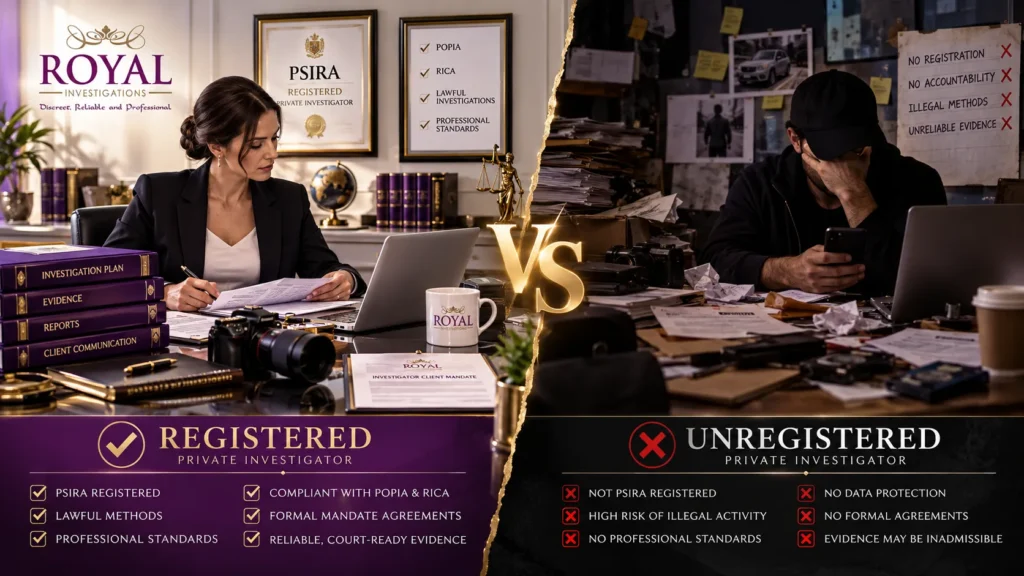
1. Lack of accountability
An unregistered operator may be difficult to identify or hold accountable.
A professional investigation should be conducted through an identifiable business or investigator with clear registration details, contact information, terms of engagement and a written mandate.
Before appointing anyone, ask for their PSiRA details and independently verify them.
2. Your personal information may be exposed
Private investigators regularly handle extremely sensitive information, including identity documents, addresses, photographs, financial information, relationship information, employment details and information concerning criminal allegations.
The Protection of Personal Information Act 4 of 2013 (POPIA) establishes conditions for the lawful processing of personal information.
Clients should therefore ask how their information will be collected, stored, protected and disclosed.
An investigator who casually distributes confidential information through unsecured devices, uncontrolled cloud storage or unnecessary third parties creates avoidable risks.
3. Illegal investigation methods can create serious problems
A professional investigator should never suggest that paying a fee gives them unlimited access to another person’s private information.
Be cautious of claims such as:
- “We can hack their WhatsApp.”
- “We can get their private cellphone records.”
- “We can access their emails.”
- “We can clone their phone.”
- “We can install spyware.”
- “We can track them anywhere.”
The fact that somebody claims to have access to information does not mean that obtaining it is lawful.
A legitimate investigation should be based on lawful information gathering, proper investigative methodology and respect for applicable privacy and communications laws.
4. Evidence may become difficult to use
A professional investigator should be able to explain where information came from, when it was obtained, how it was obtained and how it was preserved.
This becomes particularly important where an investigation may eventually support civil proceedings, disciplinary action or a criminal investigation.
South Africa’s Constitution provides for the exclusion of certain evidence obtained in violation of rights where admitting it would render a trial unfair or otherwise be detrimental to the administration of justice.
The lesson is straightforward:
Do not allow an investigation to create an evidentiary problem that could have been avoided.
5. You may end up paying twice
An unusually cheap investigation can become expensive if the work has to be repeated.
Poorly conducted investigations may result in:
- Incomplete surveillance
- Unverified information
- Missing documentation
- Weak witness statements
- Poor evidence preservation
- Incorrect identification
- Inadequate reporting
The client may then have to appoint another investigator to establish what should have been properly investigated the first time.
Price is therefore only one consideration. Registration, experience, methodology, reporting and accountability also matter.
What Should a Professional Investigation Include?
A professional investigation should begin with a clear understanding of the client’s objective.
Depending on the matter, the investigation may include:
- A written mandate
- Case assessment and planning
- Lawful information gathering
- Interviews and enquiries
- Surveillance
- Background investigations
- Tracing
- Document analysis
- Digital evidence assessment
- Evidence preservation
- Regular progress reporting
- A comprehensive final report
The investigator should also explain what cannot legally be done.
That is an important distinction between professional investigation and operators who promise unrealistic results.
Where Registration Matters Most
Private investigation covers a wide range of disciplines.
Surveillance and Infidelity Investigations
Surveillance may be required in suspected infidelity, employee misconduct, insurance matters or other disputes. Proper surveillance should focus on factual observations and lawful evidence gathering.
Fraud and Corporate Investigations
Businesses may require investigations into suspected fraud, theft, procurement irregularities, conflicts of interest, employee misconduct or other internal concerns.
Cybercrime Investigations
Modern investigations increasingly involve online scams, phishing, business email compromise, sextortion, impersonation, cryptocurrency-related matters and digital evidence.
A legitimate cyber investigation is not the same as hacking somebody’s account.
Asset Tracing and Due Diligence
Asset tracing may involve investigating corporate interests, business relationships, property-related information and other legally accessible sources.
It does not provide an investigator with unrestricted access to private banking information.


Missing Persons and Tracing
Investigators may assist with locating missing persons, witnesses, debtors, beneficiaries or other individuals relevant to a legitimate investigation.
Background Investigations
Background and due-diligence investigations can assist individuals and businesses before entering employment, commercial, financial or other significant relationships.
How to Check an Investigator Before Hiring Them
Before appointing an investigator, ask:
- Are you registered with PSiRA?
- Can I verify your registration?
- Is the investigation business properly registered?
- Who will actually conduct the investigation?
- What is included in the written mandate?
- How will my personal information be protected?
- What investigative methods will be used?
- How will evidence be preserved?
- Will I receive a written report?
- What are the costs and exclusions?
PSiRA provides online services through which consumers can verify registration information.
A registration number displayed on a website should not simply be accepted without verification.


Royal Investigations: Professional Investigation With Accountability
Royal Investigations provides professional private investigation services to individuals, businesses, attorneys and organisations across South Africa.
Our investigative categories include surveillance, fraud investigations, corporate investigations, cybercrime investigations, asset tracing, background checks, missing-person investigations, infidelity investigations, employee misconduct and litigation-support investigations.
Clients requiring a private investigator in South Africa can access nationwide investigative services.
Royal Investigations also assists clients requiring a private investigator in Cape Town, including personal, corporate, surveillance, fraud and cyber-related investigations.
Investigative services are also available to clients requiring a private investigator in Pretoria.
Clients in Gauteng can also access professional investigative services through our private investigator in Johannesburg service.
For clients seeking professional investigative assistance generally, our private investigator services page provides an overview of our investigative disciplines and approach.
Royal Investigations believes that an investigation should be conducted lawfully, discreetly and professionally. We do not promote hacking, unlawful access to private accounts or other shortcuts that may compromise an investigation.
The objective is not simply to obtain information.
The objective is to establish facts and report those facts professionally.
Frequently Asked Questions About What Private Investigators Can Legally Obtain
Is it illegal to hire an unregistered private investigator?
The Private Security Industry Regulation Act regulates security services and includes performing the functions of a private investigator within the definition of a security service. Clients should therefore verify that the person or business providing the service is appropriately registered or otherwise lawfully entitled to provide the relevant service.
Can a private investigator legally access someone's WhatsApp?
An investigator should not claim that they can simply hack or unlawfully access another person’s WhatsApp account. Access to private communications is subject to applicable laws and legal restrictions.
Can private investigators obtain cellphone records?
Clients should be cautious of anyone promising private cellphone records without explaining the lawful basis for obtaining them.
Can a private investigator conduct surveillance?
Yes. Surveillance is a recognised area of private investigation, but it must be conducted lawfully and professionally.
Can a private investigator investigate a cheating spouse?
Private investigators may conduct lawful surveillance and other investigative enquiries in matters involving suspected infidelity. The purpose should be to establish facts rather than manufacture evidence.
Can a private investigator trace someone?
Lawful tracing investigations may be undertaken where there is a legitimate investigative purpose and the applicable legal requirements are observed.
Can a private investigator find hidden assets?
Asset tracing can identify information concerning assets and financial interests through lawful investigative methods. It does not provide unrestricted access to confidential banking information.
Does POPIA apply to private investigators?
Private investigators processing personal information must consider POPIA and other applicable legislation. The Act establishes conditions for lawful processing and includes requirements concerning accountability, purpose and security safeguards.
What should I do if an investigator promises to hack a phone?
Treat the promise as a serious warning sign. Ask for the lawful basis of the proposed activity and do not provide passwords, authentication codes or access credentials merely because someone claims to be an investigator.
There has been in a significant increase
What should I do if an investigator promises to hack a phone?
Treat the promise as a serious warning sign. Ask for the lawful basis of the proposed activity and do not provide passwords, authentication codes or access credentials merely because someone claims to be an investigator.
There has been in a significant increase
Investigation Continuity
Another overlooked risk is what happens to an investigation if the investigator becomes unavailable, closes their business or abandons the matter. Clients should consider whether case records, investigative notes, photographs and other work product can be securely retained and transferred if necessary. A professional investigator should have appropriate procedures for maintaining continuity, ensuring that an investigation does not simply disappear when the person conducting it is no longer available.
Conclusion
Choosing a private investigator is not a decision that should be based simply on price, promises or how quickly someone claims they can obtain information. An investigation can involve highly sensitive personal, financial, commercial and legal information, and the consequences of using the wrong person can extend far beyond the investigation itself.
At Royal Investigations, we believe that professional investigation requires accountability, discipline and a clear understanding of the legal and practical boundaries within which investigators operate. Our approach is centred on properly assessing each matter, establishing clear investigative objectives, protecting sensitive information and conducting enquiries responsibly and lawfully.
We do not promote shortcuts, unrealistic promises or methods that could place a client at unnecessary legal or reputational risk. Our role is to establish facts, follow appropriate investigative procedures and provide clients with information that can assist them in making informed decisions.
Whether the matter involves fraud, corporate misconduct, asset tracing, surveillance, matrimonial investigations, tracing, background investigations or other complex enquiries, the investigator you appoint can have a direct impact on the outcome and the risks you face along the way.
If the matter is important enough to investigate, it is important enough to investigate properly.
Royal Investigations provides professional, discreet and legally focused investigative services across South Africa.
there is no reliable publicly available national figure for unregistered private investigators, while PSiRA’s own regulatory material confirms that unregistered businesses and officers are recognised compliance concerns.
Royal Investigations is committed to professional, discreet and accountable investigative services.
We encourage prospective clients to look beyond the cheapest quotation and consider the investigator’s professionalism, experience, procedures and approach to the matter.
When sensitive information and important decisions are involved, the question should not simply be “How much will the investigation cost?” It should also be “Who am I trusting with this investigation, and how will it be conducted?”