
You won the judgment. The court agrees you are owed the money. Then the sheriff comes back with a nulla bona return: nothing of value found. Yet the debtor still drives a new double-cab, the family still holidays in Plettenberg Bay, and the business still trades. The money hasn’t disappeared. It has been moved, hidden or registered in someone else’s name.
We hear this frustration often at Royal Investigations. A court order is only worth something if you can find assets to enforce it against. If you are new to the subject, start with our guide on what an asset trace investigation is. This article answers a question clients ask almost every week: what types of assets can a private investigator actually trace in South Africa?
The Short Answer
A registered private investigator can trace almost any asset that leaves a paper, digital or human trail, including:
- Immovable property and antenuptial contracts
- Vehicles, boats and aircraft
- Company directorships and shareholdings
- Trusts and the assets held inside them
- Investments, shares and unclaimed dividends
- Retirement funds and insurance policies
- Cryptocurrency
- Offshore assets
- High-value movables such as livestock, equipment and art
- Intellectual property and income streams
- Assets recently transferred to relatives or associates
What an investigator can’t lawfully do matters just as much, and we cover that below.
Why Asset Tracing Matters in South Africa Right Now
- Fraud is going digital. According to SABRIC’s 2024 crime statistics, digital banking fraud accounted for 65.3% of reported incidents. Cases nearly doubled from 31,612 to 64,000, and losses rose from R1 billion to more than R1.4 billion.
- Vehicle finance fraud is surging. Vehicle Asset Finance fraud rose almost 50% in 2024, with potential losses estimated at R23 billion, as fraudsters used cloned vehicles and synthetic identities.
- Billions go unclaimed. The FSCA has put unclaimed assets owed to South Africans at around R88 billion. That includes over R51 billion in retirement benefits belonging to more than 4.3 million members.
- The company register is shifting. In January 2025, the CIPC began mass deregistrations of companies that hadn’t filed Annual Returns and Beneficial Ownership declarations. Reports put the number at more than 800,000. Assets held in deregistered companies can get tangled up, so searches need to be current.
Wealth is now spread across more registries, platforms and structures than ever, and finding it takes a proper method.


1. Immovable Property
Most South African asset searches are built around property. It’s valuable and hard to hide completely, and it’s recorded across 11 Deeds Offices overseen by the Deeds Registration branch. A search by ID or registration number shows registered properties, purchase prices, transfer dates, previous owners and mortgage bonds. The bonds show roughly how much equity may exist.
The Deeds Office also keeps antenuptial contracts. In a divorce, it can change everything to know whether a spouse married in or out of community of property, and whether the accrual system applies.
A basic search only covers property in the subject’s own name. The real work is checking properties held by their companies and trusts, and by relatives who “bought” property shortly before litigation began.
2. Vehicles, Boats and Aircraft
Vehicles are registered on eNaTIS, which separates the owner (the person using the vehicle) from the title holder (often a bank). The luxury SUV your debtor drives may still legally belong to a finance house, which affects whether it can be attached.
Investigators identify vehicles linked to the subject, their companies and family members, and check whether each one is financed. They also search commercial fleets, boats and aircraft. Field work then confirms where the vehicles are kept overnight and who actually drives them.
3. Company Interests and Shareholdings
Many wealthy South Africans own very little in their own names. Their wealth sits in private companies, close corporations and holding structures. CIPC records let investigators map:
- Every active and deregistered company the subject has been involved with
- Co-directors who may be nominees or family members
- Companies sharing addresses, auditors or directors
- Directorships resigned shortly before a dispute began
Beneficial ownership records and private companies’ financial statements aren’t public. The full picture comes from linking related records, open-source intelligence and field enquiries.
4. Trusts and Trust Assets
Trusts are one of the most popular ways to protect family wealth, and one of the most common places people try to hide it. All trusts must register with the Master of the High Court. Since April 2023, trustees have had to lodge beneficial ownership registers, but only the NPA, FIC and SARS can access them.
Investigators therefore work from the outside in:
- identifying trusts where the subject is a trustee, founder or beneficiary
- finding property and vehicles registered to those trusts
- documenting whether the subject treats trust assets as their own
Where a trust is just someone’s alter ego, South African courts may take its assets into account, particularly in divorce.
5. Investments, Shares and Unclaimed Dividends
Investigators can’t see investment statements without legal process. They can spot signs of investments through JSE directors’ dealings, listed company disclosures and business links. Tracing helps families too: in 2025, the JSE urged South Africans to claim their share of R4.5 billion in unclaimed dividends. Deceased estates regularly turn up shareholdings nobody knew about.
6. Retirement Funds and Insurance Policies
Retirement benefits are largely protected from creditors, with exceptions for maintenance and divorce orders. Tracing uncovers pension interests a spouse “forgot” to disclose, and it helps beneficiaries recover lost money. Many unclaimed benefits belong to former mineworkers from the migrant labour era. The FSCA’s unclaimed benefits search is a good place to start. In August 2026, National Treasury proposed a central system for handling unclaimed financial assets.
7. Cryptocurrency
Crypto is no longer the perfect hiding place. The FSCA declared crypto assets financial products in 2022. By December 2025 it had approved 300 of 512 licence applications from crypto service providers (DLA Piper summary). Licensed exchanges keep identity records for their customers.
Investigators identify which platforms a subject uses, follow transactions on public blockchains and link wallet activity to real people. That gives your attorney what they need to subpoena an exchange. Blockchains hide names, but every transaction stays visible.
8. Offshore Assets
Mauritius, the UK and the UAE are common destinations for South African wealth. Offshore tracing means:
- identifying foreign companies and trusts
- searching public foreign registers
- following local transactions that point abroad
- working with vetted partner investigators
South Africa takes part in the OECD Common Reporting Standard, so hiding money offshore is riskier than it used to be. That often pushes people towards structures an investigator can identify.


9. High-Value Movables
Livestock and game, plant and machinery, art, jewellery and stock-in-trade often have no central register. In the Free State, Limpopo or the Eastern Cape, a farmer’s herd may be worth more than the farm. Tracing these assets means site visits, auction records, discreet enquiries and, surveillance.
10. Intellectual Property and Income Streams
Trademarks, patents and designs are recorded at CIPC. Investigators also look for rental income, franchise royalties and major client contracts, including government tenders. Knowing who pays the debtor can support a garnishee order, and it’s often more useful than knowing what they own.
11. Recently Transferred Assets
When litigation, divorce or sequestration looms, assets move fast:
- property transferred to a spouse for a nominal amount
- vehicles re-registered to relatives
- directorships resigned
- cash converted into crypto
The Insolvency Act allows certain transfers to be set aside, but only once someone finds them. Comparing what a person owned two years ago with what they own today is often the most revealing step. That’s why asset searches are important before litigation.


What a Private Investigator Can't Legally Do
A legitimate investigator will never:
- obtain bank statements without a subpoena or court order
- hack devices or accounts
- intercept communications in breach of RICA
- impersonate police or bank officials
- handle personal information in breach of POPIA
Evidence obtained unlawfully can be thrown out, and it can expose you to liability. The investigator’s job is to find where assets are, within the confines of the law.
A Typical Case
Here’s a scenario we see often. A Johannesburg supplier wins a R1.8 million judgment against a contractor who says he is insolvent. A Deeds Office search on the contractor himself shows nothing. The wider trace finds three things:
- a family trust that bought two sectional title units eighteen months earlier
- a new company in the spouse’s name, trading from the same yard
- plant equipment still in daily use on site
The supplier now has real assets to go after.
Warning Signs Someone May Be Hiding Assets
- A lifestyle that does not match declared income
- Sudden director resignations or new companies in a relative’s name
- Property or vehicles transferred to family before a dispute
- Refusal to make financial disclosure in divorce proceedings
- Claims of insolvency while the business keeps trading
How Royal Investigations Conducts an Asset Trace
At Royal Investigations, every trace follows a structured, lawful process:
- Scoping: clarifying whether the goal is enforcement, divorce, fraud recovery or due diligence.
- Identity verification: confirming ID numbers, aliases and associates.
- Registry searches: Deeds Office, CIPC, trust and vehicle records, including historical data.
- Link analysis: mapping connections between people, companies, trusts and addresses.
- Open-source intelligence and field work: verifying lifestyle, vehicles and business activity.
- Court-ready reporting: clear findings your attorney can act on.
We serve clients nationwide, including asset tracing in Cape Town, asset tracing services in Johannesburg and asset tracing across Gauteng. For a more targeted search, see our asset search service and asset searches in Pretoria.
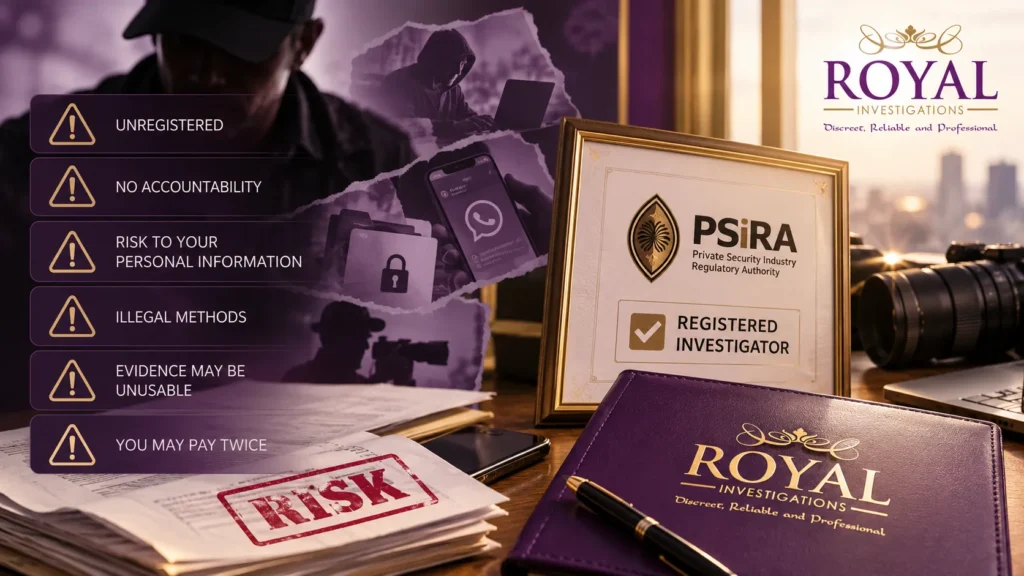
Choosing an investigator: always confirm registration with the Private Security Industry Regulatory Authority (PSiRA), because working as a PI without it is a criminal offence. Ask how they comply with POPIA, which the Information Regulator oversees. Be wary of anyone who promises bank statements or guaranteed results.

Frequently Asked Questions About What Private Investigators Can Legally Obtain
1. Can a private investigator find hidden assets in South Africa?
Yes. A PSiRA-registered investigator can lawfully identify property, vehicles, companies, trusts and other assets. They use registries, open-source intelligence and field work, often following links to relatives and related entities.
2. Can a private investigator access my spouse's bank account?
No. Bank records require a subpoena or court order. An investigator can work out which banks are likely involved, so your attorney can request the records lawfully.
3. How do I find out what property someone owns?
Search the Deeds Office using an ID or registration number. A professional search also covers related companies, trusts and relatives.
4. How much does an asset search cost?
It depends on scope. Registry searches are affordable. Complex traces involving trusts, field work or offshore enquiries cost more. We quote upfront after a consultation.
5. How long does an asset trace take?
Basic searches take a few working days. Investigations involving several entities or offshore links may take several weeks.
6. Can cryptocurrency be traced?
Basic searches take a few working days. Investigations involving several entities or offshore links may take several weeks.
7. Can assets held in a trust be traced?
Yes. Investigators identify linked trusts and the assets registered to them. Whether a court treats those assets as the person’s own is a legal question, and the evidence from the trace supports that argument.
8. Is asset tracing legal in South Africa?
Yes, when conducted by a PSiRA-registered investigator using methods that comply with POPIA, RICA and other legislation.
9. Should I do an asset search before suing someone?
Yes. It shows whether there is anything to recover before you pay legal costs, and whether assets are already being moved.
10. Can I trace assets of someone who has left South Africa?
Often, yes. Their South African assets can be traced directly. Foreign assets can be traced through public foreign registers and partner investigators abroad.
11. What happens after assets are found?
Your attorney can seek attachment, garnishee orders, preservation orders or interdicts. The findings also strengthen your hand in settlement negotiations.
12. Can an investigator find unclaimed pension or insurance money for my family?
Yes. Tracing can identify former employers, funds and insurers linked to a deceased or missing relative, especially where records are incomplete.
Final Thoughts
Wealth rarely vanishes. It moves into trusts, companies, relatives’ names, crypto wallets and offshore structures. An asset trace shows you what someone actually owns. That matters whether you are enforcing a judgment, going through a divorce, recovering from fraud or vetting a business partner.
Ready to find out what is really there? Contact Royal Investigations today for a confidential consultation.